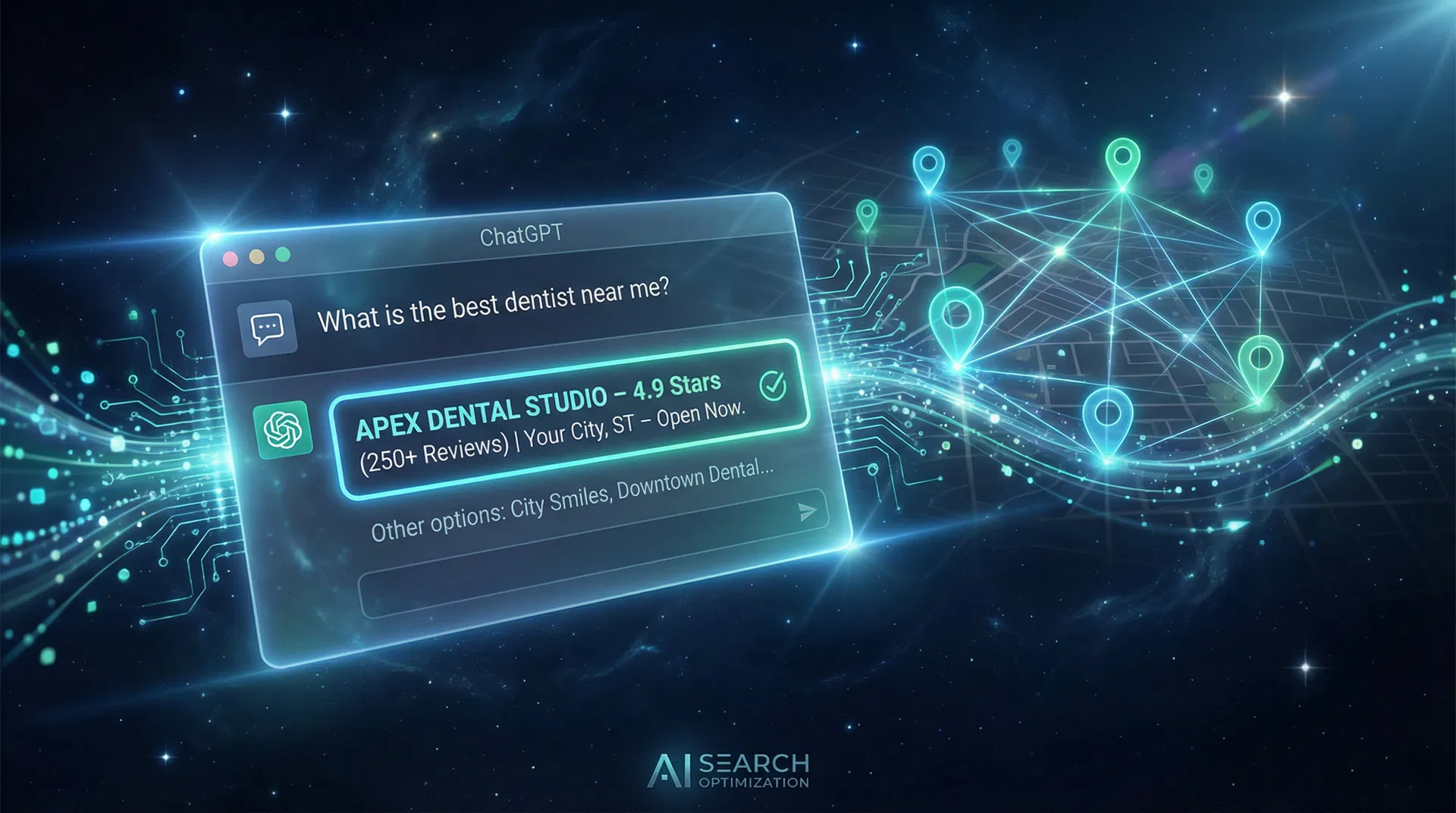
How to Rank in ChatGPT
for Local Searches
Something significant shifted in early 2026. Millions of people stopped typing "best plumber near me" into Google and started asking ChatGPT instead. The question is no longer whether AI search is coming — it's already here. The question is: is your business showing up when it matters?
- 1Some customers now use AI tools while researching local services, so clear business information is worth reviewing alongside your Google presence.
- 2ChatGPT may use information from Google and other public sources, so clear local SEO fundamentals remain useful context.
- 3The 5 key signals for ChatGPT visibility are: Google reviews, GBP completeness, structured data, authoritative backlinks, and consistent citations.
- 4A phased plan can help you improve foundations, content, and authority over time; the pace and outcome will vary by business and market.
- 5Businesses can improve their information for AI search without assuming that being early guarantees an advantage or a ranking.
How ChatGPT Decides Who to Recommend
ChatGPT and other large language models don't have real-time access to the internet in the same way Google does. Instead, they draw on a combination of trained knowledge, web browsing (when enabled), and — crucially — structured data signals that they've learned to trust. These signals are almost identical to the ones Google has used for years to rank local businesses.
When a user asks "What's the best HVAC company in Sioux Falls?", ChatGPT doesn't flip a coin. It surfaces businesses that appear consistently authoritative across multiple trusted sources: Google Business Profile, review platforms, local directories, and well-structured websites. The businesses that rank in AI search are, overwhelmingly, the same ones that rank well in traditional local SEO — because both systems are built on the same foundation of trust.
"AI doesn't invent recommendations. It surfaces businesses that have already earned trust signals across the web. If you're not building those signals, you're invisible — not just on Google, but on every AI platform too."
— OnlineBoost.ai, 2026
The 5 Signals That Make ChatGPT Cite Your Business
These five practical signals are useful areas to review when you want search systems to understand your business more clearly. They do not predict or guarantee recommendations.
Google Business Profile — Fully Optimized
Highest ImpactYour Google Business Profile is an important local information source. AI models have been trained on vast amounts of Google data and treat a complete, active GMB as a strong authority marker. This means: accurate name, address, phone, categories, current photos, useful posts, and authentic recent reviews.
Review Volume & Recency
CriticalAI systems can use review quality, recency, and relevance as trust signals. Volume alone is not enough, and businesses should focus on a consistent, policy-compliant process for inviting honest customer feedback.
Keyword-Rich Website Content
High ImpactAI models browse the web and index page content. A website that clearly states what you do, where you do it, and who you serve — using natural language that mirrors how customers ask questions — gives search systems clearer context. Service pages with FAQ sections can answer the kinds of questions people ask AI.
Local Citations & Directory Consistency
Medium ImpactAppearing consistently across Yell, Thomson Local, Yelp, TripAdvisor, and industry-specific directories tells AI models that your business is real, established, and trustworthy. Inconsistencies in your name, address, or phone number across these platforms actively reduce your AI visibility — the model loses confidence in which version is correct.
Schema Markup & Structured Data
Technical EdgeSchema markup is code added to your website that explicitly tells search engines (and AI crawlers) what your business is, what it does, and where it operates. LocalBusiness schema, Service schema, and FAQ schema are the three most impactful for local AI visibility. Most local business websites have none of this — which means implementing it is an immediate competitive advantage.
Visible vs. Invisible: What Separates the Two
The gap between businesses that appear in AI search and those that don't is not about luck or industry. It's about the presence or absence of specific, measurable signals. Here's what that looks like in practice:
| Signal | AI-Visible Business | AI-Invisible Business |
|---|---|---|
| Google Business Profile | Complete, active, weekly posts | Incomplete or abandoned |
| Review profile | Recent and authentic feedback | Outdated or limited feedback |
| Review recency | Recent activity | Little recent activity |
| Website service pages | Dedicated page per service + FAQ | Single homepage only |
| Schema markup | LocalBusiness + Service + FAQ | None |
| Directory details | Consistent information | Conflicting information |
| Social media | Active but supplementary | Primary marketing channel |
A Practical Action Plan for Improving ChatGPT Visibility
These signals can be reviewed in stages. I recommend starting with the basics, then improving content and business references as time and resources allow.
- Fully complete your Google Business Profile
- Add current photos that show your work, service area, and business
- Set up weekly GBP post schedule
- Build a consistent, policy-compliant review-request process
- Audit and fix all directory citation inconsistencies
- Create a dedicated page for each core service
- Add FAQ section to every service page
- Write location-specific landing pages
- Implement LocalBusiness and Service schema markup
- Add FAQ schema to all FAQ sections
- Add accurate listings on relevant local and industry directories
- Publish 2 blog articles answering AI-style questions
- Request 3–5 backlinks from local business partners
- Run an AI visibility audit using a representative sample of local questions
- Refine based on which queries you're still missing
Why This Is Urgent — Not Optional
AI search has continued to develop, and some customers now use it while researching local services — the ones who research before they buy, who compare options, and who trust recommendations over adverts.
Improving your website, Google Business Profile, and review process can make your business information clearer over time. These changes are not permanent guarantees, and results depend on the business, market, and search query.
Local competition varies widely. Reviewing your business information now can help you identify gaps, but no one can promise that a particular business will be recommended first or remain there.
Find Out If AI Platforms Recommend Your Business
I can review a sample of local search questions across major search and AI tools and explain what the results show. It is a snapshot, not a ranking guarantee.
Takes 30 seconds to book · No commitment required
Looking for trade-specific help?
See the local HVAC marketing page →